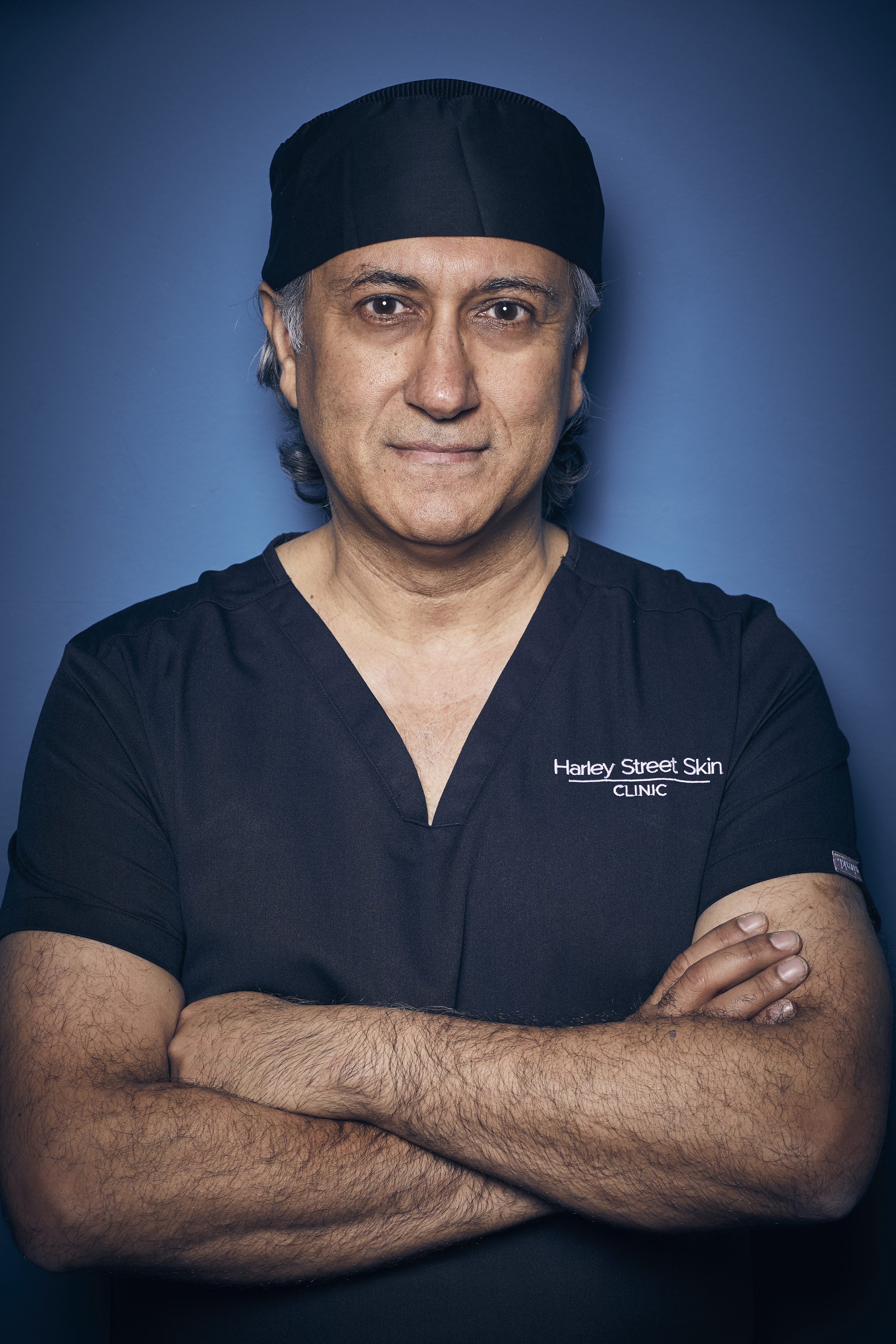





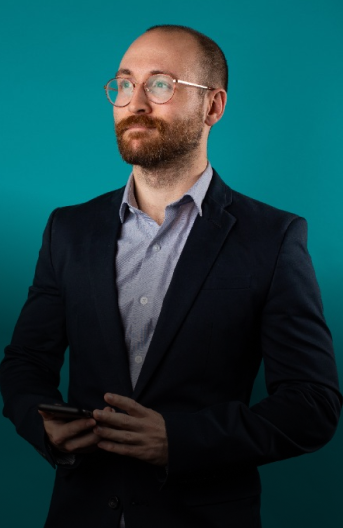

By Dr Aamer Khan
Why the stars are turning to non-surgical aesthetics to turn back the clock
Hollywood has always understood the power of looking good. But the beauty ideal has changed.
There was a time when achieving a more youthful appearance was almost synonymous with surgery. Facelifts, eyelid surgery and liposuction were the go-to solutions for anyone wanting a significant transformation.
Today, we have a much bigger and considerably more sophisticated toolkit.
Advances in lasers, radiofrequency, ultrasound, injectables, skin boosters, regenerative treatments and medical skincare mean that we can often improve the way someone looks without changing who they are.
And that, increasingly, is what people want.
The new Hollywood ideal isn’t a face pulled so tight that it no longer moves. It is beautiful skin, a defined face, good facial proportions and looking rested, healthy and full of vitality.
The ultimate compliment is no longer:
“You’ve had work done.”
It is:
“You look amazing. Have you been on holiday?”
That is the philosophy behind much of modern aesthetic medicine.
Eva Longoria: tightening without the scalpel
Eva Longoria is a good example of how aesthetic technology can be used to enhance the body without traditional surgery.
Longoria has spoken about using EvolveX, a non-invasive radiofrequency and electromagnetic treatment, to help tighten and tone her abdomen following the birth of her son. She has also discussed having Morpheus8 on her face and neck, although this is a different type of treatment because it combines radiofrequency with microneedling.
This is an interesting example of how far body-contouring technology has come. Rather than removing tissue surgically, energy-based treatments can be used to stimulate tissue and improve firmness and definition.
For the right patient, it can be a very attractive proposition: no surgical incision, no general anaesthetic and considerably less disruption to everyday life.
Of course, the results aren’t equivalent to removing large amounts of excess skin surgically, and I would never suggest otherwise. It means we are treating a different problem.
Victoria Beckham: the power of great skin
Victoria Beckham is another celebrity whose beauty approach illustrates the move towards skin quality rather than simply changing facial structure.
Beckham has publicly discussed undergoing laser resurfacing and has spoken positively about the effect it had on her skin.
Lasers are among the most versatile tools in aesthetic medicine. Depending on the technology and the patient’s concerns, they can address pigmentation, sun damage, redness, uneven texture and signs of ageing, while some lasers can stimulate collagen production.
And this is where I think people sometimes underestimate non-surgical aesthetics.
Improving the quality of the skin can completely change the way a face looks.
You don’t always need to lift or fill something. Sometimes you need to make the skin itself healthier, smoother, clearer and more luminous.
Hailey Bieber: skin first
Hailey Bieber has also helped popularise the idea that good aesthetics is about skin health and quality rather than simply removing wrinkles.
Bieber has discussed treatments including PRP with microneedling, PRF and light laser treatments, while also talking openly about her extensive skincare routine.
PRP, PRF and microneedling are not non-invasive because they involve needles, but they are non-surgical.
What I find particularly interesting is the philosophy behind this approach.
We don’t need to eradicate every line to make someone look fantastic.
In fact, a face that retains some movement and character can look far more attractive than one where every expression has been eliminated.
Cate Blanchett: maintenance matters
Cate Blanchett has spoken about using red-light treatment as part of her approach to looking after her skin, an example of how gentler technologies can form part of a broader maintenance strategy.
LED and red-light therapy are much gentler propositions than some of the more intensive aesthetic technologies, but that doesn’t mean they have no place.
I often describe these treatments as part of a maintenance strategy.
Think about how you look after your teeth. You don’t have one dramatic dental treatment and then forget about them for the next ten years. You brush, maintain them and have regular check-ups.
Skin is no different.
Good skincare, sun protection, appropriate treatments and healthy lifestyle habits can all work together to keep skin looking its best.
Kim Kardashian: where “non-surgical” gets interesting
Kim Kardashian has publicly discussed using Morpheus8 for skin tightening on her stomach.
Morpheus8 is an excellent example of why we need to understand terminology.
It is non-surgical, but it isn’t completely non-invasive. It uses microneedles to deliver radiofrequency energy into the skin and underlying tissue.
For some patients, treatments in this category can produce impressive improvements in firmness and texture without conventional surgery.
But they should still be treated as medical aesthetic procedures, with proper assessment, appropriate settings and an experienced practitioner.
Non-surgical doesn’t mean no medical expertise is required.
Quite the opposite.
The technology may be sophisticated, but the skill lies in knowing who should have it, where it should be used, how aggressively it should be performed and when another treatment would be more appropriate.
The Hollywood Toolkit
So, if someone comes to me and says, “I want to look better, but I don’t want surgery,” what are the possibilities?
There is no single treatment. The best results usually come from choosing the right combination for the individual.
1. The Zero-Needle Approach
For people who want genuinely non-invasive treatment, options can include:
- LED and red-light therapy
- Radiofrequency skin tightening
- Ultrasound-based treatments
- Appropriate laser treatments
- Medical-grade facials
- Chemical peels
- Advanced skincare
- Selected body-contouring technologies
These treatments can improve skin quality, firmness, tone, texture and radiance.
The advantage is that many can be incorporated into a patient’s normal life, although downtime varies considerably between technologies.
2. The Tweakment Approach
Then there are non-surgical treatments that involve needles.
These can include:
- Botox
- Skin boosters
- Biostimulators
- Polynucleotides
- PRP and PRF
- Carefully placed dermal fillers
The objective isn’t to create a new face. It is to subtly restore what has changed with age, improve balance and allow someone’s natural features to remain recognisable.
3. The Advanced Non-surgical Approach
There is also a growing middle ground between a conventional facial and surgery.
Radiofrequency (RF) treatments use controlled heat to warm the deeper layers of the skin, stimulating collagen production and helping to improve firmness and texture. Some RF treatments work on the surface of the skin, while others deliver energy deeper into the tissue.
Morpheus8 takes this a step further, combining microneedling with radiofrequency energy. Tiny needles penetrate the skin before delivering RF heat at controlled depths, stimulating collagen and elastin while helping to tighten and remodel the tissue. It can be particularly effective for improving skin laxity, texture and definition, including around the lower face, jawline and neck.
There are also minimally invasive treatments such as Endolift and FaceTite, which can provide more significant tightening and contouring.
Endolift uses an incredibly fine laser fibre inserted just beneath the skin. The laser delivers controlled heat into the deeper tissues, stimulating collagen production and causing tissue to contract and remodel. It can also help reduce small pockets of fat around the jawline, jowls, chin and neck.
FaceTite works differently, using radiofrequency energy delivered through a small probe beneath the skin. The controlled heat causes collagen fibres to contract while stimulating new collagen production, and can also address small areas of unwanted fat. It is particularly useful for defining the lower face, jawline, chin and neck.
Thread treatments offer yet another option, using dissolvable threads placed beneath the skin to provide an immediate mechanical lift while stimulating collagen over time.
These treatments sit on a spectrum between non-invasive aesthetics and a surgical facelift. They don’t remove and reposition skin in the way surgery does, but can offer progressively more significant tightening and contouring.
Modern aesthetic medicine has therefore become remarkably sophisticated. There is now a spectrum of options between skincare and surgery, allowing treatments to be matched to the degree of ageing, skin laxity and the result an individual wants to achieve.
It’s About Enhancement, Not Erasure
It is tempting to look at a celebrity’s appearance and assume there must be one treatment responsible for the result.
In reality, aesthetic outcomes are influenced by many factors and, where treatments are involved, often by a combination of approaches.
Good skincare. Sun protection. Nutrition. Exercise. Sleep. Appropriate technology. And, when necessary, carefully selected medical aesthetic treatments.
Rather than waiting until ageing has created significant laxity and then trying to correct everything in one operation, we can take a more preventative and maintenance-led approach.
That doesn’t mean surgery is obsolete.
There are times when surgery is the most appropriate and effective solution, particularly where there is significant skin laxity or tissue descent.
But surgery shouldn’t automatically be the starting point.
For many people, it doesn’t need to be the destination.
My philosophy is simple: the goal isn’t to make a 50-year-old look 25.
It is to make them look like the best possible version of themselves at 50.
The most successful aesthetic treatment is often the one nobody can identify.
If someone looks at you and thinks:
“You look fantastic. Have you changed something?”
rather than:
“You’ve obviously had your face done,”
then we’ve probably got it right.
That, to me, is true Hollywood glamour.
Not looking different. Looking better.
About Dr Aamer Khan
Dr Aamer Khan is a leading cosmetic doctor and co-founder of the award-winning Harley Street Skin Clinic in London. With more than 35 years’ medical experience, he is renowned for his expertise in advanced non-surgical aesthetics, regenerative medicine and skin health. A pioneer in his field, Dr Khan has treated thousands of patients and is a regular television and media expert, advising on the latest developments in aesthetics, anti-ageing and longevity. His approach focuses on subtle, natural-looking results that enhance rather than alter a person’s appearance.
Disclaimer
Celebrity examples: We should never assume what an individual celebrity has or hasn’t had done. The examples in this article refer only to treatments that the celebrities themselves have publicly discussed or that reputable media sources have reported. Where a treatment has not been personally confirmed by the celebrity, this is made clear in the wording. They should not be taken as confirmation of an individual’s complete aesthetic or medical history, nor as an endorsement of any particular treatment. Results vary from person to person and depend on factors including skin type, age, anatomy and the skill of the practitioner.