



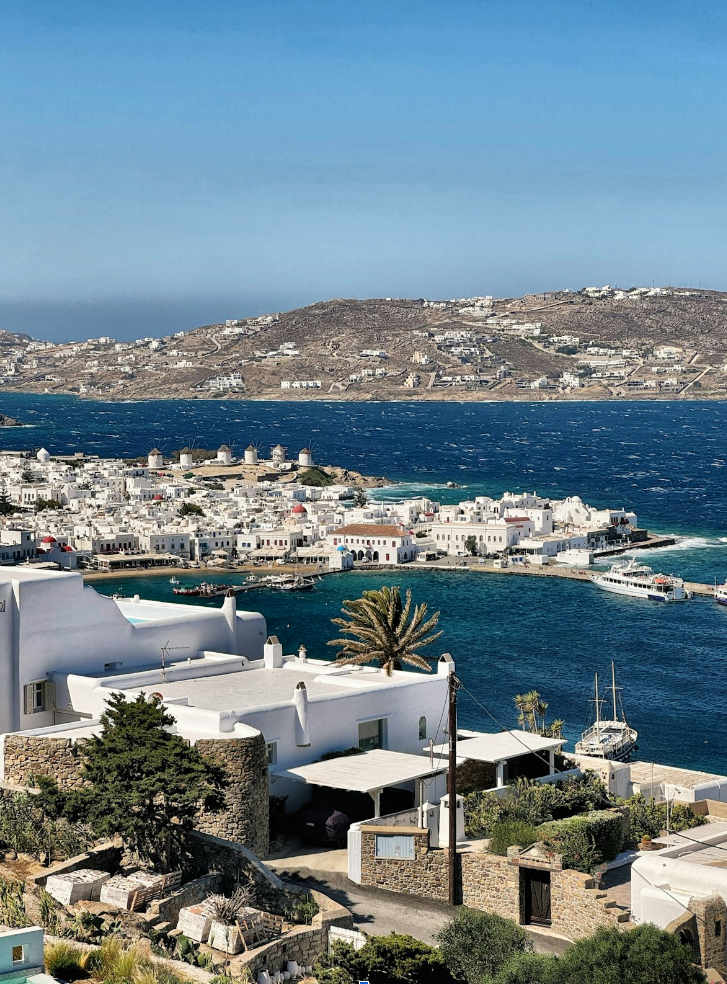
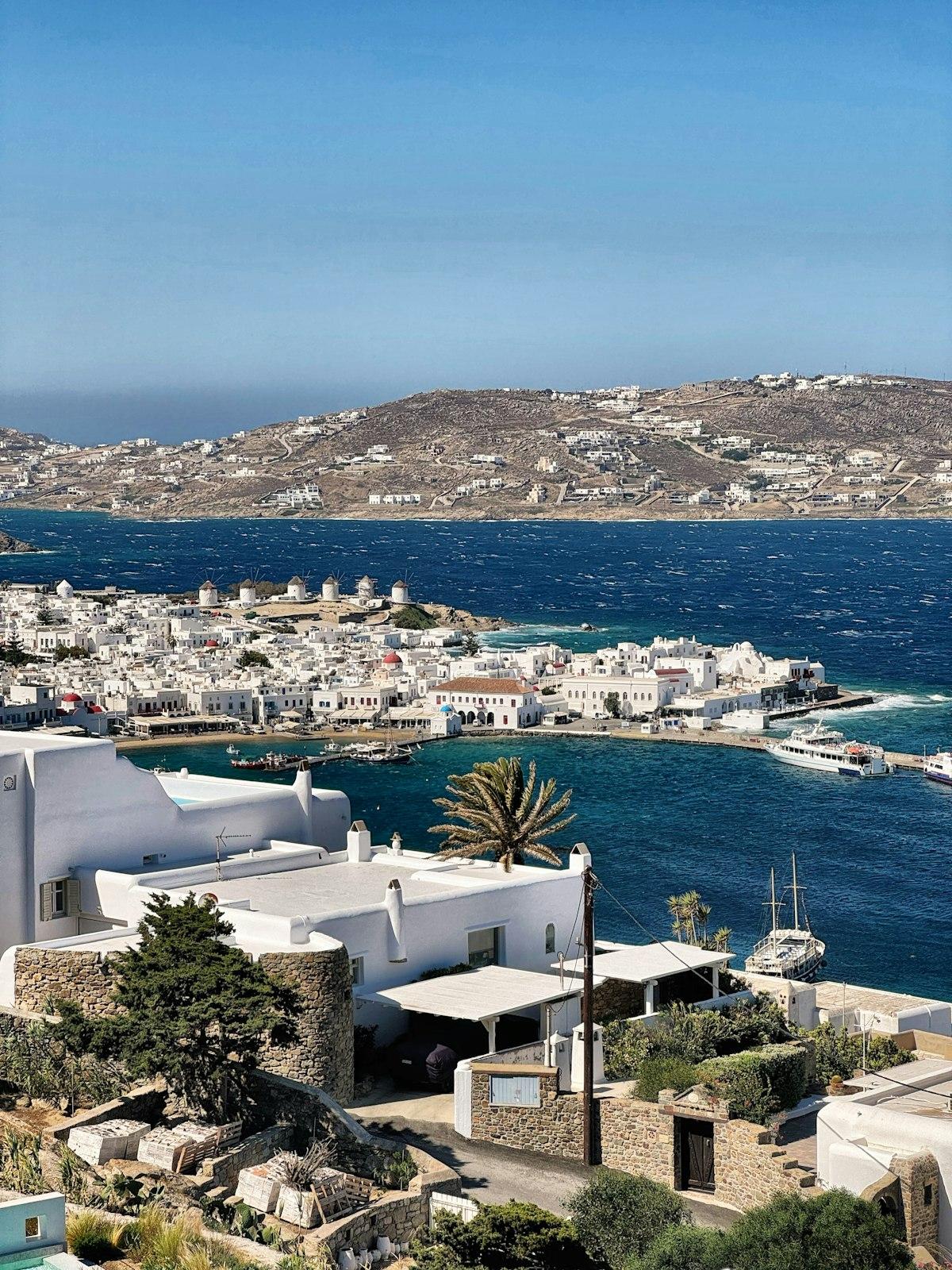
For decades, the Cyclades were defined by one image: whitewashed cubes, blue doors and narrow lanes. A new generation of island homes is adding something heavier to that picture.
Raw board-formed concrete, dry-stone walls and deep shadow now sit beside lime-washed volumes. The result is a coastal style that feels both ancient and modern.
Two Traditions With More in Common Than You Think
The Cycladic Vernacular
Traditional island houses were built from local stone, with thick walls, small openings and flat roofs. Lime whitewash sealed the surface and reflected the summer sun.
On Mykonos, farmers built dry-stone walls called samari to enclose their land. Their whitewashed tops drew white lines across the island’s granite landscape.
Brutalism
Brutalism takes its name from béton brut, French for raw concrete. It favours heavy materials left visible rather than hidden behind cladding.
Both traditions rely on mass, simple geometry and honest materials. That shared logic is why the fusion works.
Where the Fusion Began: The Xenia Hotels
Greece’s National Tourism Organisation launched the Xenia hotel programme in 1950. From 1957, its buildings were designed by a team led by architect Aris Konstantinidis.
His Mykonos Xenia, designed in the late 1950s near the island’s windmills, took its cue from the samari walls. It later reopened as the Mykonos Theoxenia.
The project showed that modernist buildings could belong to a Cycladic landscape instead of competing with it.
What Today’s Architects Are Doing
Board-Formed Concrete Meets Dry Stone
On Antiparos, Biris Tsiraki Architects paired dry-stack walls, built from stone excavated on site, with exposed board-formed concrete roofs, slabs and a cantilevered pool.
The stone ties the house to its hillside. The concrete adds sharp horizontal lines and long overhangs that throw deep shade.
Heritage Without Nostalgia
On Mykonos, K-Studio’s Mandra house uses whitewashed volumes and stone. Its architects describe the goal as “un-nostalgic architecture that bridges heritage and locality with contemporary life.”
That phrase sums up the movement. It respects island tradition without copying it.
Why Heavy Materials Suit the Aegean
Stone and concrete both have high thermal mass. They absorb heat during the day and release it slowly, which helps keep interiors more comfortable in summer.
Figures from the sustainable building resource GreenSpec show how wide the gap is. A cubic metre of stone stores around 2,300 kJ per degree and concrete around 2,000 kJ, while timber stores about 780 kJ.
That is why, in these homes, timber usually appears in doors, shutters, pergolas and furniture rather than walls.
Cycladic vs. Brutalist vs. Fusion
| Feature | Traditional Cycladic | Brutalist | Brutalist-Cycladic Fusion |
| Main materials | Local stone, lime whitewash | Exposed concrete | Stone, board-formed concrete, lime render |
| Form | Small cubic volumes | Large monolithic masses | Low volumes set into the slope |
| Colour | White with coloured doors | Grey | White, stone tones and raw grey |
| Openings | Small windows | Deep, repeated openings | Wide glazing under deep overhangs |
| Landscape | Follows terraces and walls | Often stands apart | Built into the terrain |
Experiencing the Style on Mykonos
Mykonos is one of the best places to see old and new island architecture side by side. Many private villas now pair traditional whitewash with contemporary design.
For travellers who want a stay that blends island tradition with modern design, Bright Blue Villas offers a collection of ultra luxury Mykonos villas that combine Cycladic forms with modern interiors and sea views.
Villa Kathleen I, for example, is a whitewashed home with Cycladic tones in Agios Lazaros, overlooking Psarou beach.
The Docomomo UK talk “Aris Konstantinidis Within and Without Greece”, available on YouTube, is a good introduction to the architect behind the Xenia hotels.
Frequently Asked Questions
What is Brutalist-Cycladic architecture?
It blends whitewashed Cycladic volumes and dry-stone walls with exposed concrete. The aim is a modern home that still reads as part of the island.
Who was Aris Konstantinidis?
A Greek architect (1913 to 1993) who led the design team for the Xenia hotels from 1957, including the Mykonos Xenia.
Why use exposed concrete on a Greek island?
It has high thermal mass, like stone, and allows long overhangs and cantilevers that create shade.
Can you stay in a villa built in this style?
Many Mykonos rental villas mix Cycladic forms with contemporary design, though few use fully exposed concrete. Check each property’s photos to find the balance you prefer.
A Style Built to Last
The Brutalist-Cycladic fusion is less a trend than a return to first principles: local material, solid walls and shade.
As more architects work with both stone and concrete, the Cyclades look set to keep their white silhouette while gaining a stronger, quieter structure beneath it.