








The flight is the easy part. Seven hours of ordered calm, a flat bed, a menu you chose in advance. Then the doors open at Terminal B and you rejoin the general population: a queue that folds back on itself, a wall of drivers holding tablets, a taxi rank six deep in the rain. Nobody in first class prepared you for this, because the airline’s care ends at the jet bridge. What happens next is yours to arrange, and how you arrange it decides whether New York greets you or simply processes you.
The first hour sets the tone
You have made this crossing before, or you soon will, and you already know the truth of it: the first hour off the plane sets the tone for the whole trip. Land badly and you spend the afternoon recovering your composure instead of your bearings. Land well and the city feels, from the kerb onward, like somewhere that was expecting you.
That first hour is also the one you can least afford to improvise. You are tired in a way that hides itself, your phone is hunting for a signal, and the terminal is designed to move volume, not to look after you. This is precisely the moment to have decided everything in advance. A booked, named driver waiting past the barrier is not an indulgence at this point. It is the difference between arriving and merely landing, and it is the reason a serious traveller treats a luxury chauffeur service in New York as part of the itinerary rather than an afterthought bolted on at the end.
Think of the arrival as the last leg of the journey, not the first errand of the holiday. Booked properly, it asks nothing of you. You walk out, someone takes your case, and the day opens up.
Choose the airport, then the car
New York offers three airports, and from the UK only two of them are yours. You land at JFK or Newark, never LaGuardia, which serves domestic routes and will not appear on any Heathrow departure board. You are in well-worn company: Britain is New York’s largest overseas visitor market, sending more than a million travellers a year, and London to New York remains the world’s only billion-dollar air route.
Between the two airports, the choice is worth a moment’s thought rather than blind loyalty to a frequent-flyer account. Both British Airways and Virgin Atlantic run Heathrow-to-Newark services, and Newark has a quiet advantage that regular visitors guard jealously: it reaches the West Side of Manhattan in about forty minutes via the Lincoln and Holland tunnels. If your hotel sits in Midtown, Chelsea, or the Village, Newark can put you in the lobby while the JFK crowd is still negotiating the Van Wyck. JFK earns its place for Long Island, Brooklyn, and certain schedules, but it rarely wins on time into the heart of the island.
The point is to choose deliberately. Match the airport to where you are actually sleeping, not to habit, and the ground transfer becomes short and predictable rather than a lottery. If you want the reasoning laid out in full, this guide to which New York airport to fly into from the UK does the arithmetic so you do not have to. Book the airport first. Book the car to suit it second. Do it in that order and the two halves of the arrival fit together without a seam.
What separates a chauffeur from a car app
The temptation, standing in the terminal with a working phone, is to open an app and summon whatever appears. It will appear. That is not the same as being looked after.
A ride-hailing car meets you nowhere in particular. You find the pin, you cross four lanes of pickup traffic, you confirm the driver has the right stranger, and you climb in behind whatever the algorithm sent. A chauffeur is a different arrangement entirely. He tracks the flight, so a delayed landing changes nothing. He waits inside, past the barrier, with your name in hand. He knows which terminal exit avoids the crush and which tunnel is moving at that hour. He carries the bags, holds the door, and says almost nothing unless you invite him to, because the good ones understand that a traveller fresh off a night flight wants quiet and a cold bottle of water, not conversation.
The car itself is held to a standard the app cannot promise. Clean, dark, unbranded, the temperature already right. There is no surge price invented because it happens to be raining, and no cancellation the moment something more lucrative pings the driver’s screen. You are a booking with a name, not a fare in a queue. That distinction is invisible on a good day and the whole game on a bad one, and arrival days have a way of going sideways. The value is not the leather. It is the removal of every small decision at the exact moment you have no appetite to make one.
The quiet-luxury arrival
Quiet luxury is not about what shows. It is about what you never have to notice. The best arrival is the one you cannot really describe afterward, because nothing went wrong loudly enough to remember. It is the same anticipatory service that Forbes Travel Guide rewards with its Five-Star ratings, where the finest hotels earn their standing by removing friction before a guest ever feels it, and an arrival deserves the same.
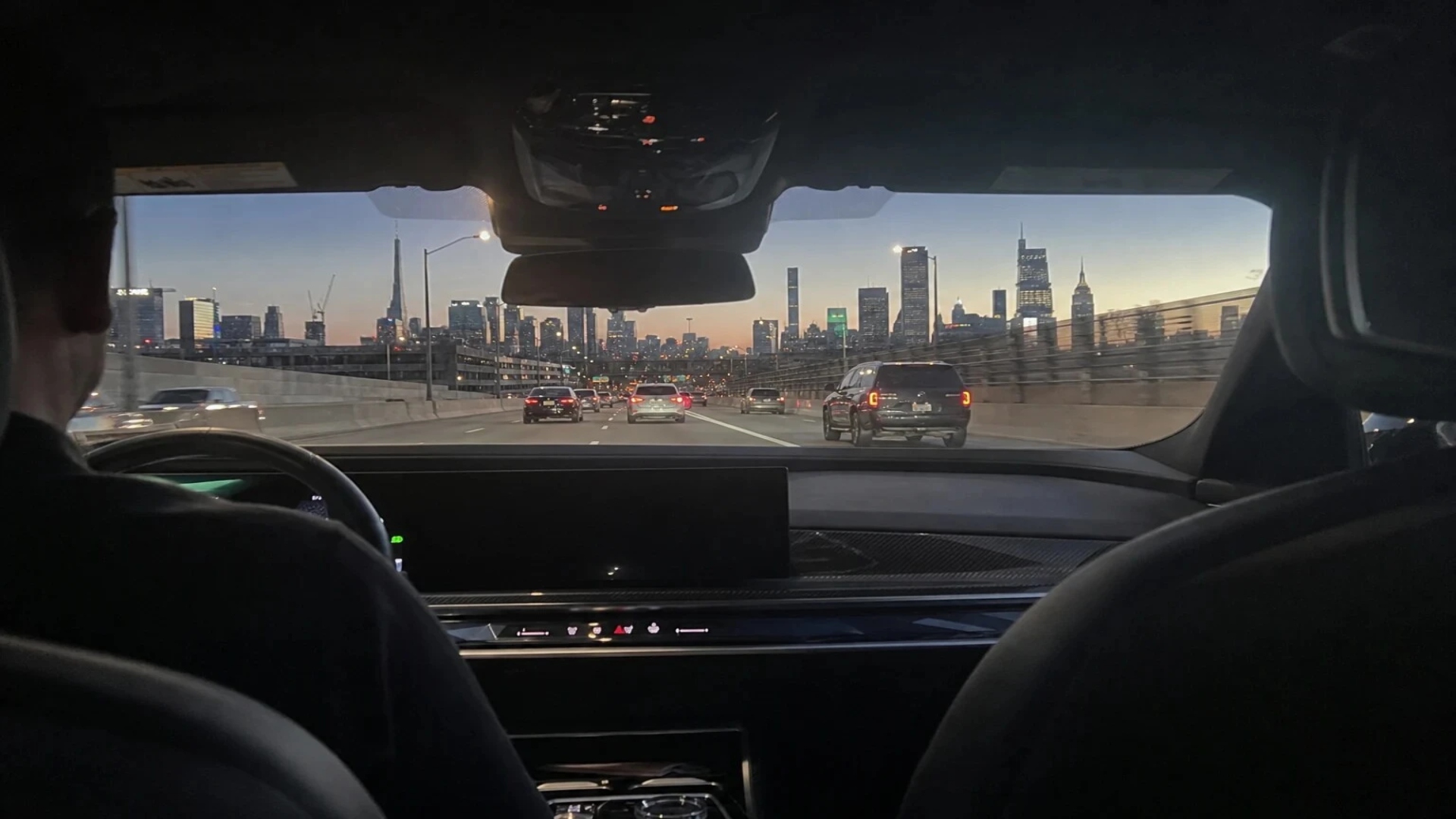
Picture it. You clear the hall, follow the signs, and a man in a dark suit steps forward with your name before you have finished scanning the crowd. Your case leaves your hand. The car is thirty seconds away, engine running, boot open. You settle in, the door closes on the terminal noise, and the West Side is forty minutes off through the tunnel. You check your messages, or you close your eyes, or you watch the skyline resolve out of the haze over the Meadowlands. Nothing is asked of you. This is what a chauffeured Newark to Manhattan transfer delivers when it is arranged with any care: not spectacle, but the absence of friction.
A note on tipping and fixed rates
There is one small mercy worth naming, because it catches out even seasoned visitors to America. The tipping question, so alien to a British traveller and so present in New York, simply does not arise here. When gratuity is built into a fixed rate agreed at booking, there is no figure to calculate at the kerb, no fumbling for cash, no doubt about whether you have given too little or too much. The fare you agreed is the fare you pay. You step out, you thank the man, you walk into your hotel. It is a quiet thing, and it is precisely the sort of quiet a good arrival is made of.
Arrange the arrival with the same care you gave the flight, and the city does the rest. You will spend your first afternoon in New York looking outward, at the streets and the light and the plans you came for, rather than back over your shoulder at a terminal you were glad to leave. That is the whole point of getting the first hour right.